
Why Do You Summit Kilimanjaro at Night?
Expert travel insights and safari tips for your Tanzania adventure with Juhudi Expedition.
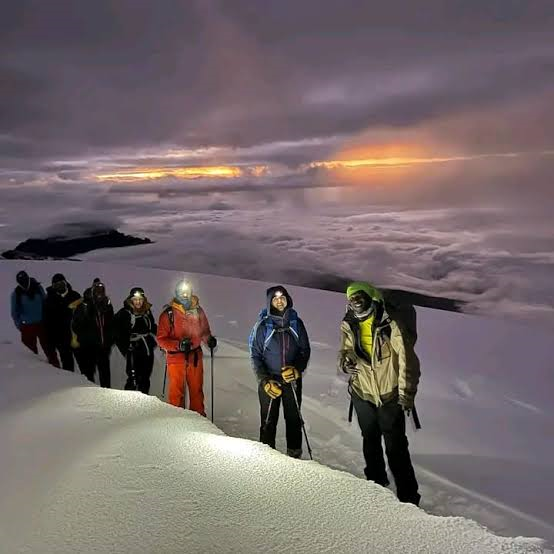
One of the most unique parts of climbing Mount Kilimanjaro is the night-time summit attempt. After several days of trekking through different landscapes and gaining altitude, climbers typically leave their high-altitude camp around midnight and begin the final ascent under a sky full of stars.
For many trekkers, walking through the darkness toward Uhuru
Peak is one of the most challenging and memorable experiences of the entire
Kilimanjaro adventure.
But why do climbers summit Kilimanjaro at night?
1. To Reach the Summit Around Sunrise
The main reason for beginning the summit climb at night is
to reach Uhuru Peak, the highest point of Mount Kilimanjaro at 5,895 meters
(19,341 feet), around sunrise.
Starting at approximately midnight allows trekkers to climb
through the night and arrive near the summit in the early morning. Watching the
sun rise above the clouds from the roof of Africa is an unforgettable
experience.
As daylight appears, the surrounding landscape can transform
dramatically, with golden light spreading across the glaciers, volcanic slopes,
and distant African plains.
2. The Snow and Ice Can Be More Stable
The summit zone of Kilimanjaro can become warmer as the sun
rises. Starting the summit attempt during the colder hours can provide firmer
conditions on sections of the trail where ice, snow, or loose volcanic material
may be present.
This is particularly useful on steep sections of the final
ascent.
3. Cooler Temperatures Make the Climb More Manageable
Although summit night is extremely cold, the lower
temperatures can make strenuous uphill walking more comfortable than climbing
the same steep terrain under the strong daytime sun.
Trekkers are normally equipped with appropriate layers,
gloves, hats, and other cold-weather gear to protect themselves from the summit
conditions.
4. To Complete the Descent During Daylight
Another important reason is the descent.
After reaching the summit, climbers normally descend back
toward the high camp while there is still plenty of daylight. This gives
trekkers better visibility and allows them to see the terrain they climbed in
darkness.
Depending on the route and itinerary, the summit day can be
very long, often involving many hours of walking.
5. To Avoid Spending Too Long at Extreme Altitude
At 5,000 meters and above, the body is exposed to
significantly less oxygen than at sea level. Spending unnecessary time at
extreme altitude can increase physical stress and the risk of altitude-related
problems.
The night-time summit strategy allows trekkers to make the
final ascent, enjoy the summit, and begin descending relatively soon afterward.
This is one reason why “climb high and descend” is an
important principle on high-altitude trekking.
6. The Summit Experience Is Truly Special at Night
There is also something extraordinary about the experience
itself.
Imagine leaving camp in complete darkness with your headlamp
illuminating the trail ahead. Around you are fellow trekkers and mountain
guides, while above you is a spectacular African night sky.
Step by step, you climb toward the summit.
As the darkness begins to disappear, the horizon slowly
changes color. Eventually, the first rays of sunlight appear above the clouds.
For many climbers, this sunrise is the emotional highlight
of their Kilimanjaro journey.
What Time Do You Start the Summit?
The exact departure time depends on the route, itinerary,
weather, camp location, and trekking company. However, summit departures
commonly begin around midnight or during the early hours of the morning.
The goal is not simply to start at a particular time. Your
guide will consider conditions on the mountain and the group's pace when
determining the appropriate schedule.
Is Climbing Kilimanjaro at Night Difficult?
Yes. The summit night is usually considered the most
demanding part of a Kilimanjaro trek.
Trekkers face several challenges:
- Extreme
cold
- Darkness
and limited visibility
- Steep
terrain
- High
altitude and reduced oxygen
- Fatigue
after several days of trekking
- A long
summit day
- The
psychological challenge of continuing upward for several hours
However, you do not need technical mountaineering experience
for the standard trekking routes. A good level of preparation, proper
acclimatization, appropriate equipment, a sensible pace, and an experienced
mountain guide can make a significant difference.
What Should You Wear for Summit Night?
Summit night is much colder than the lower sections of
Kilimanjaro, so proper clothing is essential.
Trekkers should generally prepare with:
- Warm
thermal base layers
- Insulating
mid-layers
- A warm
waterproof outer layer
- Insulated
trekking trousers
- Warm
gloves or mittens
- A warm
hat or balaclava
- Thick
trekking socks
- Appropriate
hiking boots
- Headlamp
with spare batteries
- Sunglasses
and sunscreen for the descent
We share to our customers a detailed equipment list before
your climb.
The Reward: Sunrise at Uhuru Peak
The night-time summit climb can be physically and mentally
demanding, but the reward is extraordinary.
Standing at Uhuru Peak as the sun rises over Africa, after
walking through the darkness for several hours, is a moment that many climbers
remember for the rest of their lives.
The night ascent is not simply a tradition. It is a
carefully planned part of the Kilimanjaro experience that helps trekkers take
advantage of cooler conditions, reach the summit around sunrise, and begin
their descent after achieving their goal.

